
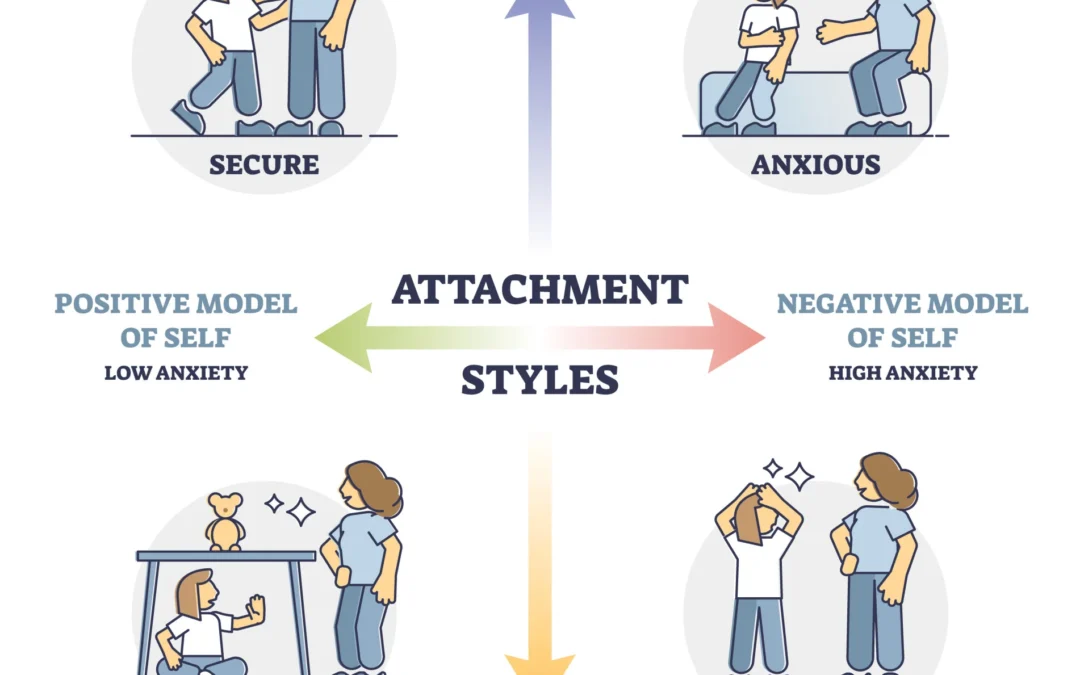
Attachment Styles Through the Polyvagal Lens
Attachment theory helps us understand why we relate the way we do. The Polyvagal Theory, developed by Stephen Porges, helps us understand what our nervous system is doing underneath it.
When we bring these two frameworks together, something powerful happens: attachment styles stop being personality flaws and start becoming nervous system adaptations.
Your attachment style is not who you are.
It is how your nervous system learned to survive connection.
A Quick Primer: The Nervous System & Safety
Polyvagal Theory describes three primary states:
-
Ventral Vagal (Safety & Connection) – You feel grounded, open, present.
-
Sympathetic (Fight/Flight) – Anxiety, urgency, activation, pursuit.
-
Dorsal Vagal (Shutdown/Collapse) – Numbness, withdrawal, disconnection.
Attachment patterns often reflect which state your system defaults to when closeness feels uncertain.
When connection feels safe → we stay regulated.
When connection feels threatened → our nervous system shifts.
Secure Attachment: Ventral as Home Base
Secure attachment reflects a nervous system that expects connection to be safe.
From a polyvagal lens:
-
Ventral vagal regulation is accessible.
-
Conflict doesn’t automatically equal abandonment.
-
Space doesn’t automatically equal rejection.
This doesn’t mean secure people never get triggered. It means their nervous system can return to regulation more easily.
They experience rupture — but they also trust repair.
Anxious Attachment: Sympathetic Activation in Connection
Anxious attachment often lives in a sympathetic state.
When connection feels uncertain, the nervous system activates:
-
Racing thoughts
-
Hyperfocus on the relationship
-
Urgency to reconnect
-
Fear of abandonment
This is not “needy.”
It is a fight-or-flight system trying to restore safety.
The body interprets distance as danger.
Protest behaviors (over-texting, reassurance-seeking, over-explaining) are attempts to regulate through proximity.
Underneath the anxiety is a nervous system saying:
“Connection equals survival. I can’t lose it.”
Avoidant Attachment: Dorsal Withdrawal or Sympathetic Independence
Avoidant attachment can show up in two nervous system pathways:
-
Dorsal vagal shutdown – emotional numbing, withdrawal, detachment
-
Sympathetic self-reliance – over-functioning, hyper-independence, control
Closeness can feel overwhelming because the body associates dependency with danger.
So the system protects itself by:
-
Minimizing needs
-
Creating emotional distance
-
Downplaying vulnerability
This isn’t coldness.
It’s protection.
The nervous system learned:
“Relying on others isn’t safe. I survive by myself.”
Disorganized Attachment: Mixed Signals in the Nervous System
Disorganized attachment often reflects a nervous system that has experienced both comfort and fear from the same source.
This creates rapid shifts between:
-
Sympathetic activation (anxious pursuit)
-
Dorsal shutdown (avoidant collapse)
It can feel confusing:
“I want closeness… but I don’t feel safe in it.”
The body oscillates between reaching and retreating.
This pattern is especially common when early attachment involved trauma, unpredictability, or emotional inconsistency.
Why This Lens Matters
When we frame attachment as nervous system states rather than character traits:
Shame softens.
Blame reduces.
Compassion increases.
You are not dramatic.
You are activated.
You are not cold.
You are protecting.
You are not broken.
You adapted.
Healing Attachment Through Nervous System Work
If attachment is physiological, healing must include the body.
Some pathways toward secure functioning include:
-
Co-regulation – Safe, consistent relational experiences.
-
Somatic awareness – Learning your cues of activation and shutdown.
-
Vagal toning practices – Breathwork, humming, safe eye contact, gentle movement.
-
Tracking triggers – Noticing what shifts you from ventral to sympathetic or dorsal.
-
Repair conversations – Rewiring safety through conflict resolution.
Secure attachment is not perfection.
It is the capacity to return to regulation after dysregulation.
A Gentle Reframe
Instead of asking:
“Why am I like this in relationships?”
Try asking:
“What state is my nervous system in right now?”
Attachment patterns are not identity.
They are nervous system stories.
And nervous systems can change.
With enough safety, repetition, and repair, the body learns a new truth:
Connection can feel safe.
Resources:
- Attached: The New Science of Adult Attachment and How It Can Help You Find–and Keep–Love https://amzn.to/3Va69fd
- Anchored https://amzn.to/3VcsQ2m
- https://www.youtube.com/@TimFletcher
- Poly vagal Card Deck https://amzn.to/4pfNiwU
- Accessing The Healing Power Of The Vagus Nerve By: Stanley Rosenberg https://amzn.to/4n85Rld
- The Body Keeps the Score: Brain, Mind, and Body in the Healing of Trauma By: Bessel van der Kolk https://amzn.to/4mTBcYN
- The Trauma Spectrum: Hidden Wounds and Human Resiliency https://amzn.to/47yiNMm
- The Body Bears the Burden: Trauma, Dissociation, and Disease https://amzn.to/4ghL2kC
