
How Trauma Lives in the Nervous System, Not Just the Mind
For decades, trauma has been framed as something that lives primarily in our thoughts: distorted beliefs, painful memories, or unresolved emotions. While the mind absolutely plays a role, this perspective misses a critical truth—trauma is not just what we remember; it’s what our nervous system learned in order to survive.
Many people who have experienced trauma say things like:
-
“I know I’m safe, but my body doesn’t feel that way.”
-
“I’ve talked about it endlessly, yet I still react.”
-
“I don’t understand why my anxiety or shutdown comes out of nowhere.”
These experiences aren’t signs of failure or resistance. They’re signs that trauma is living somewhere deeper than conscious thought.
Trauma Is a Physiological Experience
Trauma occurs when something overwhelms our system’s capacity to cope. In those moments, the nervous system—not the thinking brain—takes the lead.
Before we can analyze or make meaning, the body scans for danger through a process called neuroception. This happens automatically and beneath awareness. If the system perceives threat—whether physical, emotional, or relational—it shifts into survival mode.
That survival response might look like:
-
Fight (anger, defensiveness, control)
-
Flight (anxiety, restlessness, overthinking)
-
Freeze (numbness, dissociation, feeling stuck)
-
Fawn (people-pleasing, self-abandonment)
These responses are not choices. They are biological strategies designed to keep us alive.
When trauma is repeated, unpredictable, or occurs in relationships where safety was supposed to exist, the nervous system adapts by staying on high alert—or by shutting down to conserve energy.
Why “Talking It Through” Isn’t Always Enough
Cognitive insight can be incredibly helpful, but it has limits. Trauma responses originate in parts of the brain and body that operate faster than language and logic.
You can understand:
-
That the event is over
-
That the person is no longer a threat
-
That you are safe now
…and still experience:
-
A racing heart
-
Tightness in your chest
-
Sudden emotional overwhelm
-
Numbness or collapse
This isn’t because you haven’t processed things “correctly.” It’s because the nervous system learns through experience, not explanation.
Healing, therefore, requires more than insight—it requires new embodied experiences of safety.
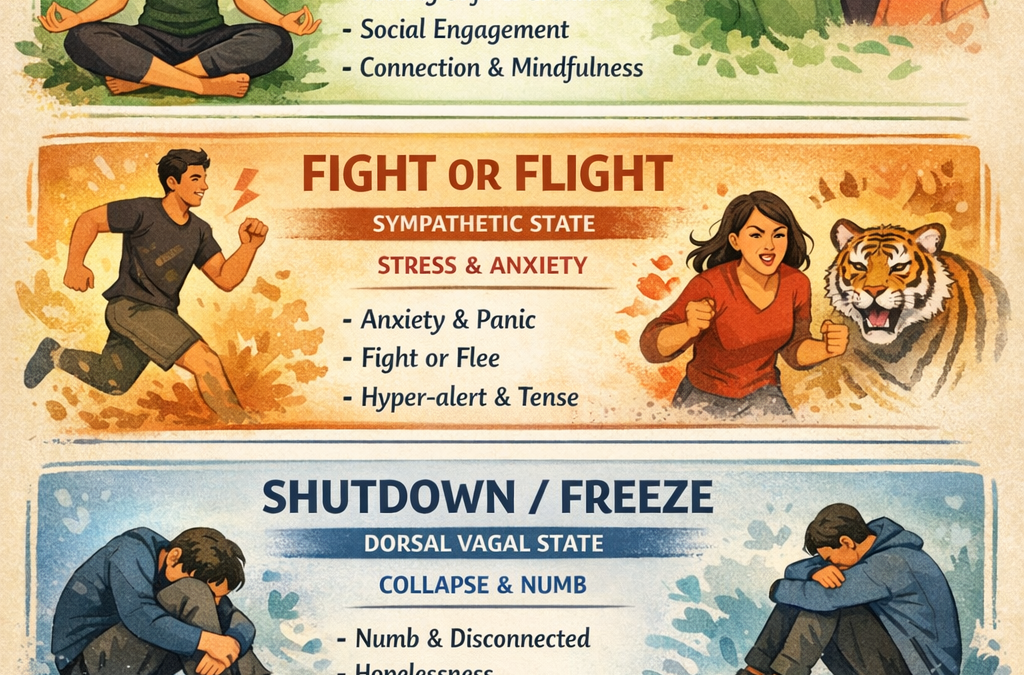
A Polyvagal Lens: How Trauma Shapes Our States
Polyvagal Theory helps us understand trauma as a pattern of nervous system states rather than a pathology.
-
Ventral Vagal (Safety & Connection): When we feel grounded, present, and connected.
-
Sympathetic (Mobilization): When we feel anxious, angry, driven, or on edge.
-
Dorsal Vagal (Shutdown): When we feel numb, hopeless, exhausted, or disconnected.
Trauma can limit our access to the ventral vagal state, making safety feel unfamiliar or even threatening. Instead, the system may default to mobilization or shutdown—even in neutral or positive situations.
This is why rest can feel uncomfortable. This is why closeness can feel unsafe. This is why calm can feel boring or wrong.
Your nervous system isn’t broken—it’s doing exactly what it learned to do.
The Body Remembers What the Mind Tries to Forget
Trauma often shows up not as memories, but as patterns:
-
Chronic tension or pain
-
Digestive issues
-
Sleep disturbances
-
Emotional reactivity
-
Difficulty trusting or receiving support
These aren’t random symptoms. They are expressions of a system shaped by past threat.
When we only approach healing through the mind, we can unintentionally reinforce the idea that the body is the problem—something to override, control, or fix.
True healing invites a different relationship: listening instead of forcing.
What Nervous System–Informed Healing Looks Like
Healing trauma doesn’t mean reliving everything that happened. It means helping the nervous system learn that the present is different from the past.
This often includes:
-
Gentle, bottom-up practices (breath, movement, sensation)
-
Building tolerance for safety and rest
-
Tracking body cues without judgment
-
Practicing regulation before expecting change
-
Experiencing co-regulation through safe relationships
Progress isn’t linear. Feeling better doesn’t mean never getting triggered—it means recovering more quickly and with less self-blame.
You Are Not Weak—You Are Adapted
If trauma lives in the nervous system, then your symptoms are not personal flaws. They are intelligent adaptations formed in response to real conditions.
Your body learned how to protect you. Your system learned how to survive.
Healing is not about erasing those strategies—it’s about updating them.
And that happens not through force, but through safety, patience, and compassion.
Because when the nervous system feels safe enough, the mind can finally rest.
Resources:
Light Therapy https://amzn.to/3KsB0kP
- The Gifts of Imperfection https://amzn.to/4n27elx
- Daring Greatly: How the Courage to Be Vulnerable Transforms the Way We Live, Love, Parent, and Lead https://amzn.to/45Z3087
- I Thought It Was Just Me (but it isn’t): Making the Journey from “What Will People Think?” to “I Am Enough” https://amzn.to/4poX7sG
- Women & Shame: Reaching Out, Speaking Truths And Building Connection https://amzn.to/47F0nJR
- Anchored https://amzn.to/3VcsQ2m
- https://www.youtube.com/@TimFletcher
- Poly vagal Card Deck https://amzn.to/4pfNiwU
- Accessing The Healing Power Of The Vagus Nerve By: Stanley Rosenberg https://amzn.to/4n85Rld
- The Body Keeps the Score: Brain, Mind, and Body in the Healing of Trauma By: Bessel van der Kolk https://amzn.to/4mTBcYN
- The Trauma Spectrum: Hidden Wounds and Human Resiliency https://amzn.to/47yiNMm
- The Body Bears the Burden: Trauma, Dissociation, and Disease https://amzn.to/4ghL2kC
